





Democrats blame House Speaker Mike Johnson (R-Louisiana) for blocking a key provision despite President Donald Trump’s support of IVF, reports the Reproductive Freedom Caucus. The House and Senate both passed the National Defense Authorization Act (NDAA), which included access to IVF coverage for active-duty service members, but the IVF provision was not included the final version of the bill.
The root of the problem was IVF language which was removed from the bill causing frustration from both Democrat and Republican lawmakers alike.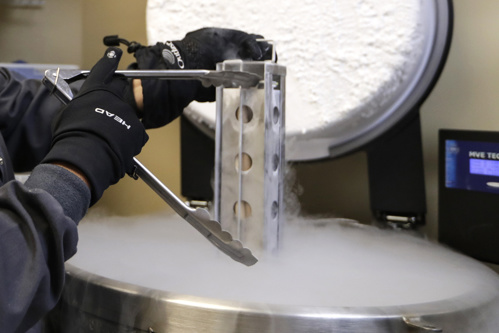
According to Rep. Adam Smith (D-Washington), Democrats seemed to all be in favor of the bill. The controversy lied in the Republican party.
“You've got a lot of Republicans who are strong supporters of IVF, and you get a lot of others that said, ‘I can't support it unless it has this pro-life language.’ So, it was a clash within the Republican conference that they could not resolve,” said Smith.
The question is why is IVF so controversial? Smith said that there was language that pro-life forces wanted to put in the bill that he believed is impractical.
Simply, pro-lifers wanted to protect the embryos that are used in IVF treatments.
Dr. Lauren Rubal, a reproductive endocrinologist and infertility physician, spoke with Tony Perkins on Washington Watch and shed some light on the situation by sharing her background in working with IVF. She says that the first thing to keep in mind is that these couples who turn to IVF are truly suffering.
“I wanted to help alleviate the suffering to help them have children, but what changed was on many different levels,” begins Rubal.

Rubal lists three reasons for her change in support of IVF treatment.
- She felt like, medically, she was not addressing the root cause of the problem but putting a Band-Aid over it instead.
- She acknowledged there are medical issues with the practice of IVF, risking complications for both the mother and child.
- She realized how many embryos were being destroyed in the process of IVF.
A human embryo is a human life. The IVF process creates multiple embryos because not every embryo will qualify for implantation. While embryos can be frozen, it’s also possible that couple doesn’t want as many children as embryos that have been produced.
“I initially went into thinking of it as helping life really in that interim process,” says Rubal. “If every embryo is a human being that is a unique chromosome complement at his or her earliest stage of development, we were just starting on average many more embryos potentially to get to that one live birth.”
Along with health implications, critics of IVF point out that there is the question of morality and ethics, especially when the embryos are destroyed, discarded, or frozen. Sadly, IVF is portrayed as the only option couples have.
Rubal mentions that, while IVF is a blanket recommendation for most infertility diagnoses, there is an alternative. It’s called Restorative Reproductive Medicine (RRM).
“That is really, again, identifying those root causes — harnessing the hormone imbalances that may be present, looking at the microbiome, trying to optimize ovulation in that woman as well as the sperm in that man, and using medical and surgical procedures to do so,” explains Rubal. “The studies actually show that this is yielding equivalent rates of live births compared to IVF cycles.”
Not only is it effective and moral, but Rubal says it is not as financially taxing for couples unlike other options. While it takes more time to yield results, she emphasizes that there is absolutely hope.
Getting the word out is a challenge
As to why this is not promoted more, Rubal states that, only speaking for herself, she was not equipped with all the tools.
“Studies that have been done looking at fertility awareness-based methods, which can double the chances of conception over a period of six months in people who are trying to conceive, show only 4% of OBGYNs and family medicine physicians were familiar with how to effectively counsel patients on these types of procedures,” says Rubal.
She believes that medical professionals are doing their best with what they are given. However, this method of reproductive care is what makes her feel much more at peace.
She calls RRM a win-win. With this procedure, babies are being born healthier, less in preterm, less in multiples and at normal weights.
“And this is what I tell patients. Not everything is in our power here, but let's try to optimize the parts that are, and then we can have a path moving forward in peace, knowing that we're going to be helping you feel better because we're going to normalize whatever we've uncovered,” states Rubal.


